NCATOD supports and empowers NC treatment professionals to enhance the quality of patient care in treatment programs by promoting the growth and development of comprehensive opioid treatment services throughout North Carolina.
About the Annual NCATOD Conference
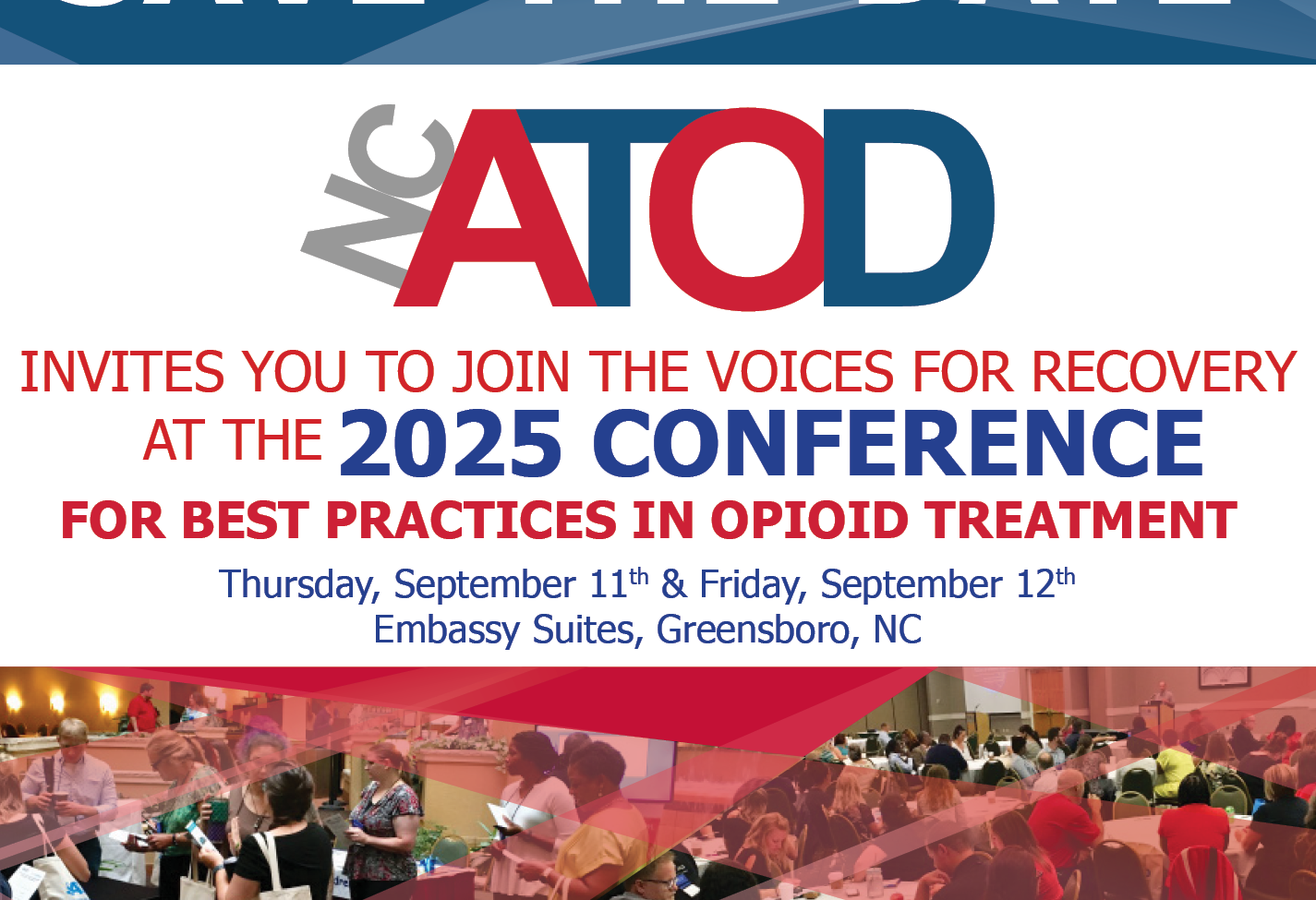
Welcome to the 2025 NCATOD Conference where we will be discussing Best Practices in Opioid Treatment! Join us in person at Embassy Suites in Greensboro for an event filled with informative sessions, engaging discussions, and networking opportunities. Learn from experts in the field, share your experiences, and gain valuable insights to improve opioid treatment practices. Sessions have been designed to meet specialized needs of nurses, counselors, administrators and support staff working in the field of Medically Assisted Treatment. Don’t miss this chance to be a part of the conversation and make a difference in the opioid treatment community. Register now to secure your spot!
NCATOD is the North Carolina affiliate of the American Association for the Treatment of Opioid Dependence (AATOD), which was founded in 1984 to enhance the quality of patient care in treatment programs by promoting the growth and development of comprehensive opioid treatment services throughout the United States.
Professional Credit Available
NCATOD has applied to NC Substance Addiction Specialist Professional Practice Board (NCASPPB) for up to 9 hours of credit. Individual credit will be awarded for each session attended, and NCASPPB credit is included with conference registration.
Who Should Attend?
This conference is for nurses, counselors and support staff working in the field of Medically Assisted Treatment, such as:
- Social Workers
- Marriage and Family Therapists
- Professional Counselors
- Mental Health Counselors
- Nurses
Thursday, September 11, 2025
4:00 – 5:30 p.m. — Registration Opens
5:30 – 6:00 p.m. — Networking Dinner
6:00 – 8:00 p.m. — Announcements, Welcome, and Opening Plenary
Announcements & Welcome
Kenny House, NCATOD President
De-Stressing in a Stressed Out World
James Campbell, LPC, LAC, MAC, AADC
Friday, September 12, 2025
7:45 – 8:30 a.m. — Registration & Networking Breakfast
8:30 – 10:00 a.m. — Morning Plenary
Announcements & Welcome
Kenny House, NCATOD President
Best Practices for HIV and HCV Prevention & Treatment in Rural Opioid Use Disorder
Dr. Ram Upadhyaya
Dr. Asher Schranz
Sponsored by Governor’s Institute
10:00 – 10:15 a.m. — BREAK
10:15 – 11:45 a.m. — Concurrent Breakout Sessions I
Session A: Nursing in the OTP | Kirstin Brockman
Session B: THC for Opioid Withdrawal | Wanda Burger
Session C: Nutritional Influences on People Undergoing Treatment for OUD |Anastassia Skarlinski
Session D: OTP Regulatory Changes Increasing Access to Care: Who Needs MOTAA? | Dr. Eric Morse
Session E: Curiosity Rocks Addiction | Linda Hamilton
11:45 – 1:15 p.m. — Luncheon Session: State Update | Kelly Crosbie, MSW, LCSW
1:15 – 2:45 a.m. — Concurrent Breakout Sessions II
Session A: Implementation of MAT Programs within Jail Settings | Tammy Vaughan and Tremaine Sawyer
Session B: Who is the “Expert”? – Peer Coaching vs. Clinical Treatment in Recovery | Garret Biss, CPRC
Session C: Opioid Settlement Funds | Nidhi Sachdeva, MPH
Session D: State Update: Rules and Policies | Pamela Morrison, LPA, LCAS, CCS
Session E: Ethical Issues in Working with Sexual and Gender Diverse Patients | Ed Johnson, LPC, LAC, LACS, MAC, CS
2:45 – 3:00 p.m. — BREAK
3:00 – 4:30 p.m. — Concurrent Breakout Sessions III
Session A: Community Paramedic | Tara Tucker
Session B: Clinical Considerations for Complete Assessment using ACES| Melissa Enoch, LCMHC, LCAS, CCS, MAC
Session C: How Disability Laws Protect People with Substance Use Disorders | Dane Mullis, LCAS, LCSW-A, Sara Harrington, Lena Welch, Lisa Nesbitt
Session D: Fetal Alcohol Spectrum Disorder | Judith Johnson Hostler
Session E: Addressing the Addiction Workforce Deficit through Project AWE | Beth Harmer, DSW, MSW, LCSW, LCAS, CCS
OPENING PLENARY: De-Stressing in a Stressed-Out World
James Campbell, LPC, LAC, MAC, AADC
James Campbell, LPC, LAC, MAC, AADC has worked professionally in the human services field for over thirty years in a wide range of clinical settings, currently serving as the Associate Director for the Southeast Addiction Technology Transfer Center. His passion is equipping providers to support individual and family wellness effectively and build on the strengths they possess and equipping the next generation of addiction professionals to serve those in their care effectively. He’s a member of both NAADAC and ACA and is a nationally recognized author and speaker.
Session Description: A number of key indicators of chronic stress are at critical levels. Diagnoses of anxiety and depression are at an all-time high. Substance misuse, overdoses, and suicide are also on the rise. As health care and human service providers, we are not immune from the pervasive effects of stress. In fact, by virtue of our roles, we are frequently at higher risk. Although self-care is often spoken of, it is much more difficult to apply and practice. Although none of us are immune to stress, there are some steps we can take to cultivate greater resilience to it.
OPENING PLENARY: Best Practices for HIV and HCV Prevention & Treatment in Rural Opioid Use Disorder
Ram Upadhyaya, MD and Dr. Asher Schranz, MD
Sponsored by Governor’s Institute
Session Description: This session will explore the rising burden of HIV and hepatitis C in rural communities affected by injection drug use. Participants will learn about the unique challenges faced by rural providers, including limited access to specialists, syringe service programs (SSPs), and medications for opioid use disorder (MOUD). Presenters will highlight evidence-based strategies—such as Project ECHO, harm reduction expansion, and co-located services—to improve prevention and treatment. Emphasis will be placed on practical, scalable solutions to strengthen care delivery and public health infrastructure for people who inject drugs (PWID) in underserved areas.
Dr. Ram Upadhyaya is a family nurse practitioner specializing in rehabilitation, with a focus on opioid use disorder. He blends clinical expertise with advocacy to support recovery.
Dr. Asher Schranz is an Associate Professor in Infectious Disease at UNC Chapel Hill School of Medicine. His research focuses on injection-related infections and substance use disorders across North Carolina and the U.S.
CONCURRENT SESSIONS I-A: Nursing | Nursing in the OTP
Kristin Brockman, NP-C
At the end of this 90 minute session, participants will be able to identify differences in the roles of RNs and LPNs based on the nursing scope of practice; increase knowledge of the rules and regulations for OTPs; increase understanding of the harm reduction model in OTPs; have ability to use COWS accurately; and be able to identify the goals of treatment.
Session Description: I have been an RN since 2009 and started working as a dosing nurse in an OTP in 2014. After completing my MSN-Family Nurse Practitioner, I continued my career in OTPs. Currently, I am a medical provider at Vance Recovery in Henderson, NC and the Morse Clinic of Durham. Caring for patients with opioid use disorder is a passion of mine. Over the past 11 years, I witnessed many patients find and maintain their recovery. My experience as a dosing nurse and nurse practitioner allows me to have a unique perspective for the nursing role in the OTP setting.
CONCURRENT SESSIONS I-B: THC for Opioid Withdrawal
Wanda Burger LCAS, LCMHCS, CCMC
In March of 2004 Wanda left Pennsylvania to work for Crossroads in Elkin, NC. She has had the honor to work in almost every program including basic and enhanced, starting as a dually licensed therapist, then supervisor, director and trainer. Currently her private practice focuses on trauma for civilians and military. In 2022 she was in the first group of therapists that were trained to conduct Forensic Evaluations. These evaluations, trauma interventions along with trainings are so rewarding. On the 3rd Saturday of each month, she is joined by many clinicians from various licenses for group supervision and training. It’s an awesome group and they love adding fellow clinicians.
Session Description:
The use and misuse of substances continues to evolve. This presentation will be an overview of several new substances that are being misused. Some, as we all understand, were invented for certain purposes and those who misuse have, once again, turned a substance that was intended for good into a harmful substance. Those who take advantage of others by selling, find more ways to market. In comparison, Older misused substances now are being reinvented successfully for recovery. The best news is that a new medication that controls pain and is non-addictive has just been approved in January 2025.
CONCURRENT SESSIONS I-C: Nutritional Influences on People Undergoing Treatment for OUD
Anastassia Skarlinski
Anastassia Skarlinski, MPH, RD, LDN is a registered dietitian most recently employed at Central Regional Hospital in Butner, NC as a clinical dietitian and at RJ Blackley in the same role before its closure. She is also a current PhD student at University of North Carolina in Greensboro, working with a concentration in Nutrition. Prior to attending UNCG she attained a Masters of Public Health from Chapel Hill and a Bachelor’s of Science from Appalachian State University both with a concentration in Nutrition.
Session Description: Anastassia is a registered dietitian most recently employed at Central Regional Hospital in Butner, NC as a clinical dietitian and at RJ Blackley in the same role before its closure. She is also a current PhD student at University of North Carolina in Greensboro, working with a concentration in Nutrition. Prior to attending UNCG she attained a Masters of Public Health from Chapel Hill and a Bachelor’s of Science from Appalachian State University both with a concentration in Nutrition.
CONCURRENT SESSIONS I-D: OTP Regulatory Changes Increasing Access to Care: Who Needs MOTAA?
Eric Morse, M.D.
Dr. Eric Morse is an Addiction and Sports Psychiatrist. Dr. Morse is the CMO of the Morse Clinics – Johnston Recovery Services in Clayton, Morse Clinics of Asheboro, Durham, Roanoke Rapids, North Raleigh, Dunn, Zebulon, Chatham Recovery in Siler City, and Vance Recovery in Henderson. All of the Morse Clinics proudly accept Medicaid and Medicare. After his residency in psychiatry at the UNC, he completed an addiction psychiatry fellowship at the University of Maryland. He won the Fred Glazer Award in 2021 and the Marie Award in 2022 from AATOD for lifetime achievement in treating opioid use disorder. At Carolina Performance in Raleigh, Dr. Morse had his 275-patient limit for buprenorphine maintenance and has been a PCSS-B mentor since it started in 2003 and is an Opioid Response Network mentor with the AAAP and SAMHSA. With 8 buprenorphine waivered physicians, Carolina Performance may be one of the largest buprenorphine OBOT providers in North Carolina. He serves as a consultant for the state in educating physicians on the proper treatment of opioid use disorder through the Governor’s Institute.
Session Description: OTP regulatory changes have led to increased access to care in NC. Medication units, mobile units, pharmacy units, telemed admissions in jails, ERs and rehabs using chain of custody forms all have made it easier to get into OTPs. How should we best use these new abilities? We will discuss the purpose, models, regulatory changes, site selections, funding and other topics that attendees would like to cover.
CONCURRENT SESSIONS I-E: Curiosity Rocks
Linda Hamilton, CADC
Linda Hamilton is a leading figure in the field of addiction recovery and mental health. As founder of Beyond Addiction, a DWI agency specializing in assisting individuals prepare for relicensing and the prevention of other DWI’s, she utilizes Acceptance and Commitment Therapy as her main model. She is also an anger Management. She aims to help individuals overcome challenges and achieve lasting change. She holds certificates in ACT and in Creative Mind Coaching, ACT Matrix coaching and Self-Compassion Trainer. Hamilton’s understanding of the therapeutic process has led to the discovery of many techniques that free individuals of various addictions.
Session Description: Curiosity could be the primary way to deal with Addiction and its destruction of happiness, family, possessions, health, and death. Defenses and resistance to change can be released by using the prefrontal cortex shift. and utilizing present moment goals.
CONCURRENT SESSIONS II-A: Implementation of Medication-Assisted Treatment (MAT) Programs within Jail Settings
Tammy Vaughan, LCSWA
Tammy Vaughan, License Clinical Social Worker Associate (LCSWA) and Program Supervisor, Sheriff’s Medication Assisted Restorative and Treatment Program. Ms. Vaughan is an experienced licensed clinical social worker who emphasizes a strong focus on mental health and substance use disorder treatment in both community and correctional settings. With over five (5) years of experience, she has worked extensively in developing and implementing Medication-Assisted Treatment (MAT) for individuals involved in the criminal justice system. Tammy is passionate about improving access to care and advocating for the integration of addiction treatment services. Her expertise in clinical practice, program development, and community partnerships have made her a trusted leader in behavioral health and criminal justice reform.
Tremaine Sawyer, LCSW, LCASA
Tremaine Sawyer, Licensed Clinical Social Worker (LCSW), Licensed Clinical Addiction Specialist-Associate (LCASA), and STARR Program Supervisor with Durham County Justice Services. He oversees the STARR Program, a trauma-informed, gender-specific substance use and behavioral health treatment program at the Durham County Detention Center. Tremaine provides clinical, administrative, and technical support for jail-based Medication-Assisted Treatment (MAT) and substance use programs across North Carolina. He is also a SAMHSA Trauma Trainer for criminal justice professionals.
Session Description: This workshop focuses on the implementation and effective management of Medication-Assisted Treatment (MAT) programs within jail settings, providing an in-depth look at how MAT can address substance use disorders among incarcerated individuals. Participants will gain an understanding of how MAT programs help reduce relapses, lower overdose rates, and increase successful reintegration into society upon release.
CONCURRENT SESSIONS II-B: Who is the “Expert”? – Peer Coaching vs. Clinical Treatment in Recovery
Garret Biss, CPRC
Garret Biss is a retired Marine Corps Pilot. Transitioning from military service was a traumatic chapter of Garret’s life; one defined by a struggle with substances and alcohol. While surviving this chapter, Garret began a journey of personal discovery and meaning which led to studying the science of human flourishing and emotional wellbeing as it pertains to recovery from addiction. Garret leverages his personal and professional experience as a presenter, certified recovery coach, and as a founder a recovery residence. His mission is to empower others towards their best recovery through curriculum development, online programs and recovery mindset coaching.
Session Description: Join us for an immersive and transformative workshop that delves into the dynamic interplay between peer coaching and clinical treatment in the roles of prevention and addiction recovery. Designed for professionals across the spectrum of services, including clinicians, coaches, and peer support specialists, this comprehensive session will provide valuable insights and strategies to promote prevention and support individuals on their recovery journey. We will explore how both peer coaching and clinical treatment aim to improve lives, each offering unique perspectives and tools. You’ll gain a clear understanding of the distinctions between these approaches, including who is considered “the expert in the room” and how they uniquely address the challenges their clients face. Learn how clinicians’; and coaches’; tools can complement each other to provide a holistic support system to bolster prevention efforts or better support those in recovery. Through real-world examples, we’ll illustrate how peer coaching and clinical treatment can work together to create a comprehensive prevention or recovery plan.
CONCURRENT SESSIONS II-C: Opioid Settlement Funds
Nidhi Sachdeva, MPH
Nidhi Sachdeva, MPH (she/her) is a thoughtful leader and passionate public health professional committed to creating healthy, safe, and equitable communities. She is a systems thinker with hopes of creating a culture of curiosity and care. Ms. Sachdeva serves as the Director of Strategic Health and Opioid Initiatives with the North Carolina Association of County Commissioners (NCACC) where she assists counties in planning for and utilizing national opioid settlement funds, implementing and evaluating health initiatives, and maximizing resources and impact through technical assistance, outreach, education, and collaboration. She has worked in public health and harm reduction in various capacities and on multiple levels within government (local and state) and research universities.
Session Description: The North Carolina Association of Count Commissioners (NCACC) strives to support local governments in utilizing opioid settlement funds to maximize resources and impact through technical assistance, outreach and training, and collaboration. This session will discuss how funds are rolled out across the state, give an overview of statewide efforts as demonstrated on the data dashboard, highlight outcomes and impacts, and discuss how to get involved.
CONCURRENT SESSIONS II-D: State Update: Rules and Policies
Pamela Morrison, LPA, LCAS, CCS
Pamela Morrison works for the North Carolina Department of Health and Human Services, Division of Mental Health, Developmental Disabilities, and Substance Use Services as a coordinator with the State Opioid Treatment Authority. Pamela has over 30 years of experience in human services as a psychologist, clinical addictions specialist, and clinical supervisor. She has dedicated the past 25 years to working in the field of opioid, substance use disorder, and mental health treatment. Prior to moving to North Carolina in the mid-90’s, she spent several years providing home-based and community-based crisis services and working in conjunction with police departments to provide crisis intervention with youth and families. She is licensed as a Psychological Associate, Clinical Addictions Specialist, and Clinical Supervisor.
Session Description:
This presentation will provide critical, time-sensitive updates related to Opioid Treatment Program (OTP) and other substance use disorder services. The presentation will include relevant updates and changes in Federal Regulations, Federal Guidelines, State Rules, NC Medicaid Clinical Coverage Policies and State-Funded Service Definitions.
CONCURRENT SESSIONS II-E: Ethical Issues in Working with Sexual and Gender Diverse Patients
Ed Johnson, LPC, LAC, LACS, MAC, CS
Ed Johnson obtained a bachelor’s degree from Auburn University and a master’s degree in clinical counseling from the Citadel. Ed is currently working as an addiction treatment and recovery related trainer and consultant. He recently retired after thirty-five years working in the field of addiction treatment, prevention and recovery. During that time, he worked providing direct addiction treatment and recovery related services in South Carolina and providing addiction treatment and recovery related training and consultation services throughout the southeast. For the past 41 years, Ed has been a person in long-term recovery from substance use disorders..
Session Description:
“First, do no harm” is the core tenet of medical and behavioral health ethics. LGBTQ+ individuals are a hidden minority in addiction treatment settings. Issues of shame and trauma specific to this population, when left unaddressed result in unsuccessful outcomes. This session will increase participant’s knowledge of the issues of affectional/ gender minorities and increase their skills for recognizing and working with this population.
CONCURRENT SESSIONS III-A: Community Paramedic
Tara Tucker, MS, EMT-P. CP-C
Innovative program design around Community Paramedicine/EMS and mental health and substance use is my specialty. With over 28 years of experience in integrative, whole person health, I design system approaches aimed at tackling the mental health and opioid crises, address system gaps, link siloed service providers, and address the health of the whole person.
My diverse experiences have provided me with a vast skill set including behavioral health, case management/care transitions, EMS, supervisory skills, quality management and data analysis, and budgeting skills. I also have experience working with software vendors to design products to meet a variety of healthcare needs. I believe holistic health & community-based treatment are paramount to helping manage chronic health conditions whether they are related to medical, mental health or substance use issues.
Session Description: The moments following an overdose represent a critical window to change the trajectory of a life. Traditionally, Emergency Medical Services (EMS) and substance use professionals have worked separately, with little collaboration. Today, Community Paramedics are bridging this gap by connecting emergency response with recovery pathways, offering rapid follow-up, evidence-based treatment linkages, harm reduction services, and in some models, low-barrier buprenorphine initiation to bridge individuals into longer-term care. At Cape Fear Valley Health, Community Paramedics have expanded this approach further by partnering with Broken Chains JC, a national network of Peer Support Specialists, to foster authentic connection, trust, and hope. Together, they ensure a response that is clinically informed and deeply person-centered. This session will explore how North Carolina’s evolving model leverages EMS and peer support partnerships to meet individuals where they are, uphold dignity and respect, initiate recovery interventions earlier, and strengthen the continuum of care beyond the immediate emergency.
CONCURRENT SESSIONS III-B: Clinical Considerations for Complete Assessment using ACES
Melissa Enoch, LPS, LCAS, CCS, MAC
Melissa Enoch is the Owner and Administrative/Clinical Director of a private outpatient facility located in Charlotte NC and Burlington NC, serving various client Populations. These include court-ordered and probation offenders and provides both individual and group counseling to fulfill court requirements. She has worked in the field of substance use and mental health disorders since 1994 in various capacities including governmental agencies, private and non-profit treatment facilities and corrections.
Session Description: Negative Impacts of ACES are significantly mitigated by having individuals with knowledge of the utilization of Protective Factors. This presentation seeks to expand the manner in which clinicians complete assessment and treatment planning to include communication of the impact of Adverse Childhood Experiences and discussion of way to help identify support systems that can aid in better outcomes.
CONCURRENT SESSIONS III-C: How Disability Laws Protect People with Substance Use Disorders
Dane Mullis, LCAS, LCSW-A is an advocate with Disability Rights NC focusing on the healthcare rights of people with Substance Use Disorder. Dane has a Bachelor’s degree in social work from Western Carolina University and Master’s Degree in Social Work from University of Kentucky. Dane has worked in harm reduction with several organizations in the Western North Carolina.
Sara Harrington is an attorney with Disability Rights NC focusing on the healthcare rights of people with Substance Use Disorder. She has advocated for friends and family with disabilities for more than 20 years. She graduated from Wake Forest University with a Bachelor’s degree. Sara received her law degree from Campbell University School of Law.
Lena Welch is an attorney with Disability Rights NC focusing on employment rights. She joined DRNC in August 2020, and previously worked on class action lawsuits as a law clerk at Disability Rights Advocates in the summer of 2019 and interned at the disAbility Law Center of Virginia in the summer of 2018. She earned Bachelor’s degrees in journalism and economics from the University of North Carolina at Chapel Hill and law degree from the University of Virginia School of Law.
Lisa Nesbitt is an attorney with Disability Rights North Carolina.
Session Description: The number of people diagnosed with substance use disorder (SUD) has significantly increased over the last decade, along with the number of reported overdose deaths. In some cases, people with SUD are protected by disability rights laws. In this training, you will learn about the background on the opioid overdose epidemic in North Carolina, treatments for SUD, how to determine whether SUD is protected by disability laws, examples of SUD discrimination in employment, healthcare, and how policy changes can improve the lives of people with SUD.
CONCURRENT SESSIONS III-D: Fetal Alcohol Spectrum Disorder
Judith Johnson- Hostler, LCMHC, LCAS, NCC, CSI
Judith is a master’s level clinician who has worked in the field of addiction for over 20 years. She is currently a student at North Carolina Central University where she is obtaining her second master’s degree. She obtained her bachelor’s degree from Thomas Edison State University (Trenton, NJ) and holds a Master’s degree in Psychological Counseling from Monmouth University (Long Branch, NJ). Presently, Judith is employed at the Alcohol Drug Council of North Carolina as the Coordinator for the state’s Perinatal Substance Use Project. She is responsible for providing training and care coordination for women seeking residential treatment and serves as a consultant to both the NC Division of Public Health/Women’s Branch of Raleigh and the Division of Mental Health/Development Disability/Substance Abuse Services in the Addictions & Management Operation Section. Her current focus of her work is addressing the opioid epidemic, focusing on pregnancy and women with children with a substance use diagnosis and the importance of integrated care coordination.
Session Description: This interactive session will provide participants with a comprehensive understanding of Fetal Alcohol Spectrum Disorders (FASD), including the impact of alcohol on the developing fetal brain and how FASD presents across the lifespan. Attendees will learn to recognize common characteristics of individuals with FASD and explore effective strategies for supporting them in the substance use treatment setting, as well as other systems of care. Practical tools and approaches will be discussed to help professionals better serve individuals with FASD or prenatal alcohol exposure, promoting more successful outcomes in treatment.
CONCURRENT SESSIONS III-E: Addressing the Addiction Workforce Deficit through Project AWE
Beth Harmer, DSW, MSW, LCSW, LCAS, CCS
Dr. Beth Harmer is a social work educator and clinician with almost 20 years of experience in mental health and addiction services for children and families. She earned her DSW from the University of St. Thomas in 2021 and her MSW from Western Carolina University in 2010. She joined the faculty at WCU in 2016 and currently serves as the Assistant Department Head for the Department of Social Work. Beyond her academic role, Beth is an active community leader, serving as President for NC Foundation of Alcohol and Drug Studies and Vice President for Addiction Professionals of NC.
Session Description:
In 2023, the rates of overdose deaths in the seven WNC counties ranged from 25.4 per 100,000 to 122 per 100,000 with six of the counties exceeding 47 per 100,000. Compared the 2023 rate of 41 per 100,00 for the state of NC, these numbers identify a significant need for prevention, treatment, and recovery services. Project AWE is an addiction workforce education and training program that aims to address the workforce deficit in Western North Carolina. The program provides professional development opportunities to Certified Peer Support Specialists by enhancing their expertise in the field and providing them with opportunities to pursue their Certified Alcohol and Drug Counselor credential and/or higher education if they so choose. The presentation will explore the current deficits in the Addiction Workforce in NC as well as data from Project AWE which is an Addiction Workforce Education and Training program aimed to help Certified Peer Support Specialists obtain their Certified Alcohol and Drug Counselor credential.
The North Carolina Association for the Treatment of Opioid Dependence once again presents the 2024 Conference for Best Practices in Opioid Treatment: Voices for Recovery, September 11th – September 12th in Greensboro, NC. Tracks have been customized to meet specialized needs in the areas of Nursing, Administration, Clinical and Leadership.
Join us by registering now. Please register early! Conference participation will be limited.
Early-Bird Rate: Full Conference*
EARLY BIRD RATES ENDED JULY 31
Online Event Registration Powered by Eventbrite.
Refund Policy
A full refund (less a $20.00 service fee) can be made for conference registration cancellations completed by 5 p.m. August 30, 2025. NO REFUNDS will be made thereafter, but a substitute participant may attend.
North Carolina Addiction Specialist Professional Practice Board
NCATOD has applied to NC Addiction Specialist Professional Practice Board (NCASPPB) for up to 9 hours of credit. Individual credit will be awarded for each session attended, and NCASPPB credit is included with conference registration
All conference related questions need to be made to: Registration@NCATOD.org.

Embassy Suites
204 Centreport Drive
Greensboro, NC 27409
The Embassy Suites in Greensboro, NC offers such great meeting rooms as well as excellent accommodations for those who need housing. The number of available rooms will meet our conference needs quite well and the negotiated price for participant housing is outstanding.
The Embassy Suites is located in the center of the Triad, just 6 miles from the Piedmont Triad International Airport at the intersection of Interstate 40 and Highway 68. They are the premier center for hospitality in the area, with a full range of services to meet every traveler’s needs. The 219, all-suite property has an elegant 7-story atrium where the fresh scent of lush greenery fills the senses. Water cascades from a luxurious fountain and sunlight radiates through the skylights overhead.
Each suite is beautifully decorated with a private bedroom and spacious living room. All of the suites have a refrigerator, microwave oven, individual cup coffee maker, two flat screen televisions, two telephones, high speed Internet and a very functional dining/work table with ergonomic chair. Choose a suite with 2 double beds or 1 king bed; in addition each suite is equipped with a queen size sleeper sofa for extra guests.
Since the NCATOD Conference registration fee does NOT include housing/lodging, special daily rates of $145.00 + tax (Two Double Beds or One King Bed, Non-Smoking), have been negotiated with the Embassy Suites. This room rate includes breakfast on Thursday morning, plus a complimentary reception Thursday and Friday evenings.
All lodging/housing arrangements must be made directly with the Embassy Suites no later than August 10, 2025
CLICK HERE TO BOOK YOUR ROOM ONLINE NOW!
Or call 336-668-4535 to make your hotel reservation.
Use Booking Code: NCATOD Meeting.
2025 NCATOD PLATINUM CONFERENCE SPONSORS


2025 NCATOD GOLD CONFERENCE SPONSORS
2025 NCATOD SILVER CONFERENCE SPONSORS




2025 NCATOD CONFERENCE EXHIBITORS
ACCU Reference
Alcohol and Drug
Council of North Carolina
Alliance Health
Brightview
Broken Chains
CARF
Chess Health
Comprehensive Treatment Centers
Cone Health
Crossroads
Curiosity Rocks Addiction
Fellowship Hall
Focused Addiction RecoveryFoundations Health
Gilead
Mallinckrodt
McLeod Centers
MedMaxRx
MedSTAT
Millennium Health
Mission Mobile Medical
Morse Clinic
NetSmart
New Seasons
NCFADS
Piedmont AHEC
Recovery Innovations
SEATTC
SDRL
Stepping Stone-Pinnacle Treatment Centers
Trillium Health
Trinity Counseling
Services
Trosa
Vista Pharm
Volunteers of America
Interested in Exhibiting at NCATOD? Become a Sponsor Today!
Download the Sponsor/Exhibitor Form Now
Pay for Sponsorships Online via the Conference Registration Link